
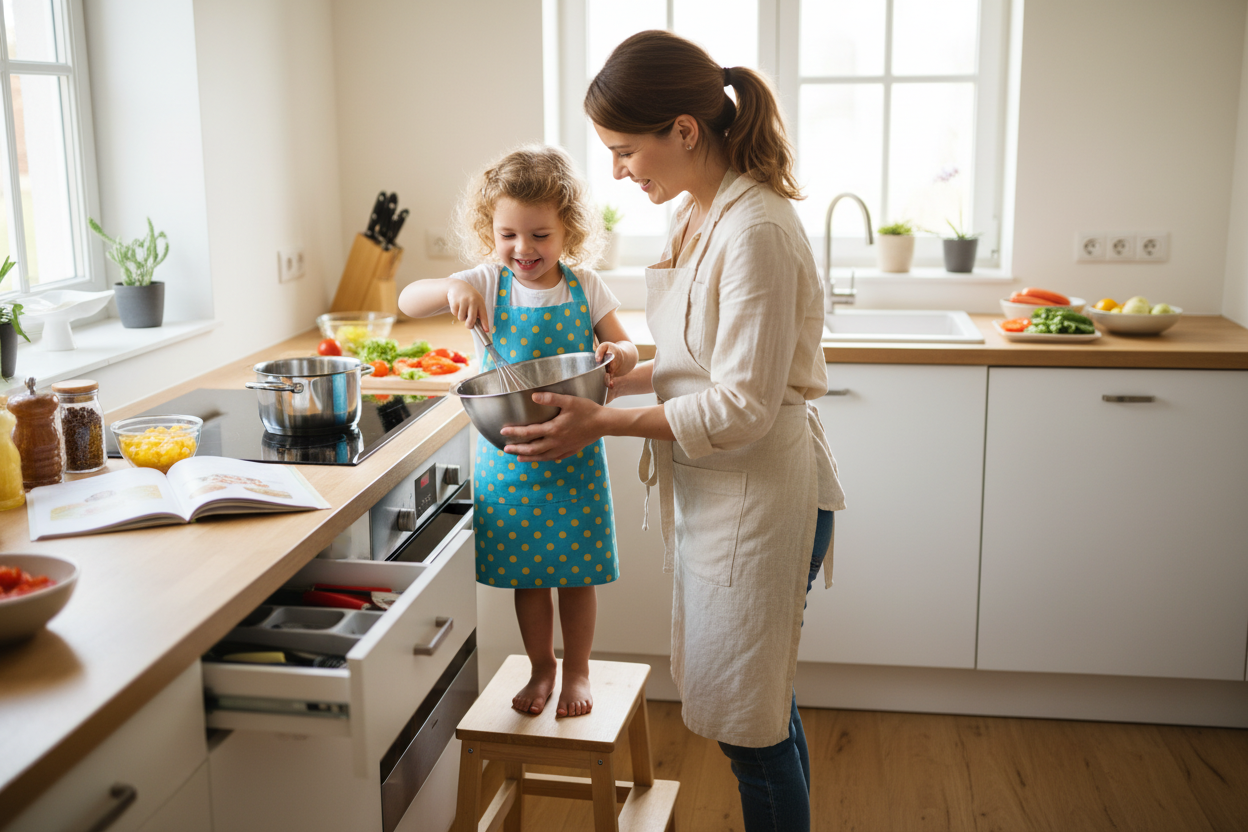
Cooking together is about sharing much more than a recipe: it's about passing on confidence, independence… and a sense of safety. With a few simple steps, the right tools, and a suitable environment, your child can participate fully while preventing accidents.
Safety, far from hindering learning, becomes a key to freedom and pleasure in cooking.
Create a safe and suitable environment.
-
Organize the space : Clear the work surface, provide a "child" area at the right height (stable step stool, small table, etc.), move sharp or hot objects out of direct reach.
-
Prepare the utensils : Choose suitable tools (Genius Cut®, non-slip board, small bowl, apron…), take them out before starting to avoid unexpected trips back and forth.
-
Explain the rules from the start : We wash our hands, we don't run in the kitchen, we ask for help to carry or cut what is difficult.
Safe cooking techniques and postures.
-
Demonstrate the correct posture : Stand with your feet firmly planted, close to the work surface, to avoid slipping or dropping objects.
-
Adopt the correct technique : Hold the knife by the handle, cut away from your fingers, and use a "crab hand" to hold the food. Demonstrate first, then let your child try it while you watch.
-
Encourage slowness : It's better to go slowly and look carefully than to rush. Make it a game ("Who can cut the most gently?").
-
Establish small rituals : A reminder of the safety rules at the beginning of the workshop, a “stop” if we feel tired or distracted.
Essential tools for preventing accidents.
-
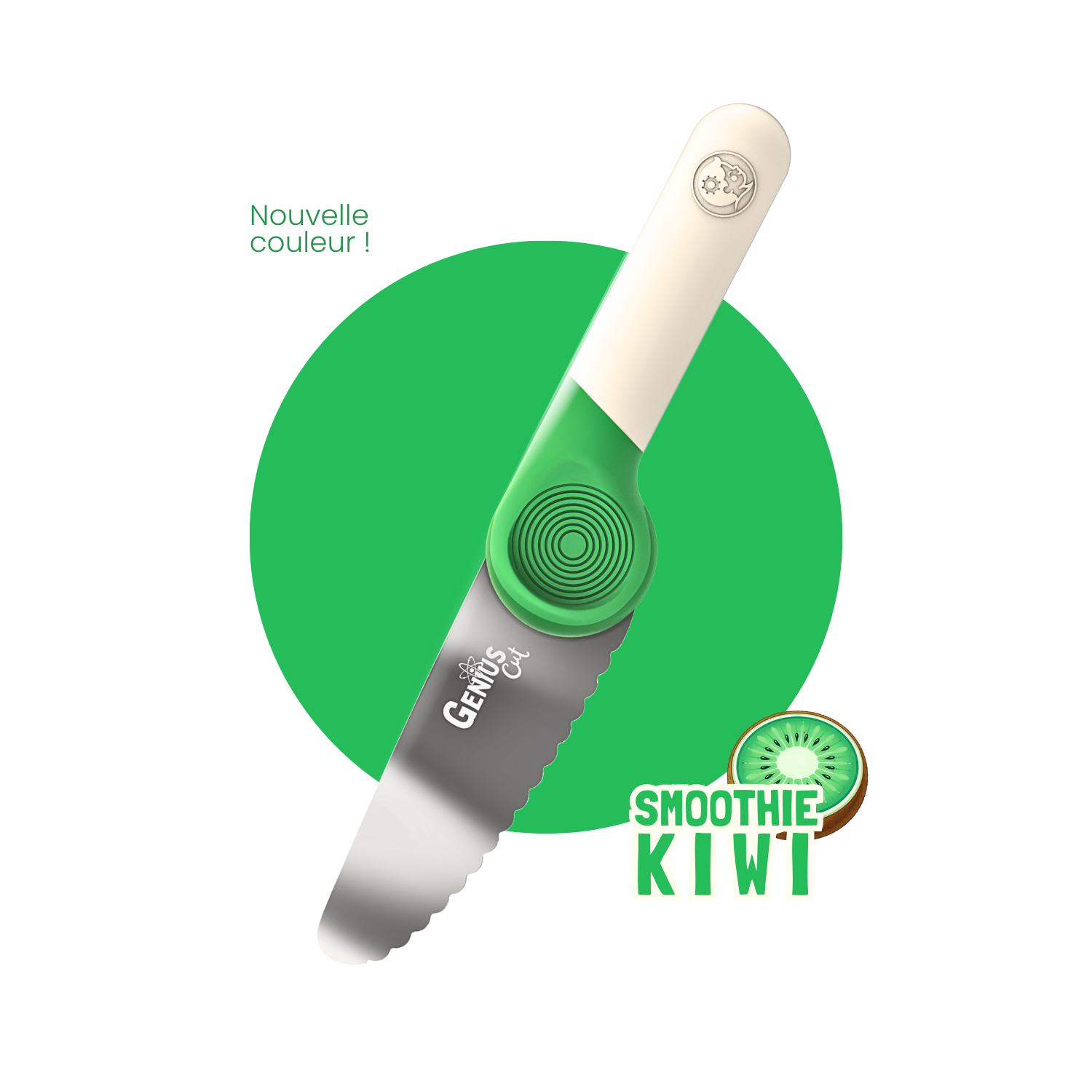
Genius Cut® Educational Knife : Designed to cut food, not fingers. Ergonomic handle, polished blade, maximum safety for fearless learning.
-
Non-slip boards : Prevent food or utensils from slipping.
-
Step stool or coffee table : So that the child has everything within reach, without having to climb on an unstable chair.
-
Apron and short sleeves : Limits the risk of stains or burns.
-
Archi Autonomy Kit : Brings together the essentials to cook like a pro, safely.
The transmission of security: empowering without causing anxiety.
Safety is also learned through dialogue and trust. Explain to your child why certain actions are important (“Cut gently so you don’t get hurt”, “Stay away from the hot pan”).
Give him age-appropriate responsibilities, let him name the dangers (“What’s hot here?”, “How do we avoid slipping?”) and praise his efforts (“You remembered to move your hand back, well done!”).
- For the youngest children, prioritize washing, mixing, and training, with close supervision.
- From 3-4 years old, the use of educational knives, peeling and participation in cutting are possible under supervision.
- Adapt the tasks to each age group, without stifling enthusiasm or dramatizing minor mistakes.
Safety is not a hindrance: it is a path towards autonomy, confidence, and the pleasure of doing everything “for real”.
Conclusion: safety and autonomy, hand in hand.
Providing your child with a safe environment allows them to learn, participate and thrive with confidence.
With the right tools and small rituals, every moment in the kitchen becomes a positive experience, where we grow together, one step at a time.
To go further, discover our educational tools (Genius Cut®, Archi Autonomie Kit…) and other tips on Les Petits Architectes.






0 comments